

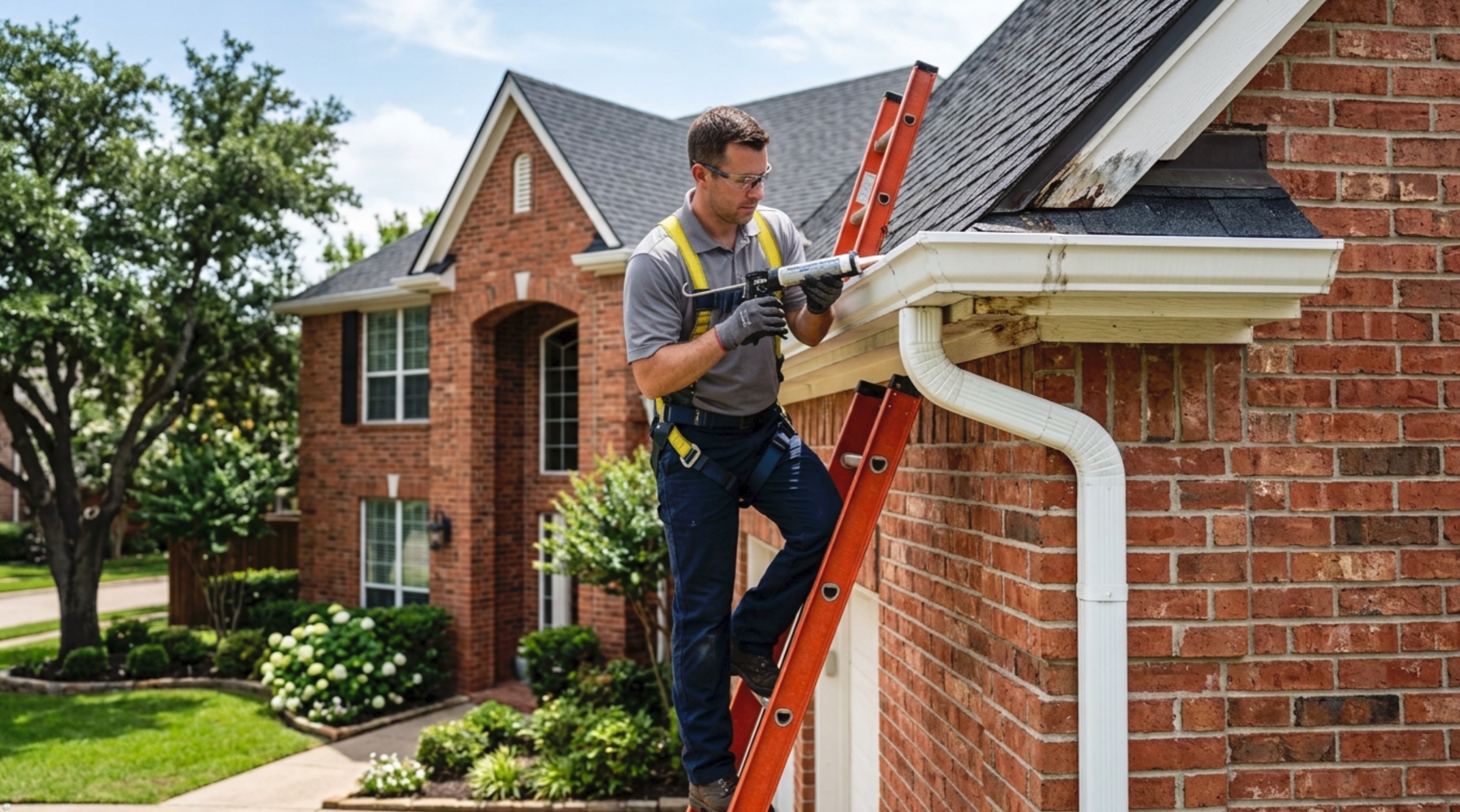
Leaking gutters can look like a small exterior problem, but the water escaping from the system may damage the fascia, roofline, siding, landscaping, and soil around your foundation.
The first step in effective gutter leak repair is identifying where the water is coming from. A gutter may leak through a failed seam, overflow because of a clog, pull away from the fascia, develop holes from corrosion, or allow water to run behind it because the system was installed incorrectly.
These problems do not all require the same repair.
Some leaking gutters can be sealed or reattached. Others are too damaged, poorly sized, or incorrectly installed to provide a dependable long-term repair. In those cases, replacing the affected section or the complete system may make more sense.
The Brothers that just do Gutters of North Dallas provides free on-site gutter inspections and estimates. Our gutter specialists evaluate the complete system and explain whether repair or replacement is the better solution for your home.
Call (469) 658-4228 to schedule your free inspection.
Why Are My Gutters Leaking?
Gutters can leak for many reasons. The location and timing of the leak usually provide clues about what is wrong.
Common causes include:
- Clogged gutters
- Blocked downspouts
- Failed gutter seams
- Loose corners and miters
- Rust or corrosion
- Cracks and holes
- Improper gutter slope
- Gutters pulling away from the fascia
- Damaged or missing sealant
- Insufficient downspouts
- Undersized gutters
- Damaged fascia boards
- Missing or incorrect drip edge
- Incorrect gutter placement
- Storm or impact damage
A homeowner may see water dripping from one area and assume that spot is the source. However, water can travel along the bottom or back of a gutter before falling somewhere else.
A thorough inspection should evaluate the full gutter run, not only the visible drip.
The Difference Between a Leak and an Overflow
Before trying to fix the gutter, determine whether water is leaking through the system or overflowing over its edge.
A true leak occurs when water passes through:
- A seam
- A corner
- A hole
- A crack
- An outlet connection
- An end cap
- A failed seal
An overflow occurs when water rises above the gutter or shoots past its edge.
Overflow may be caused by:
- Debris buildup
- A clogged downspout
- Too few downspouts
- Gutters that are too small
- Incorrect slope
- A large roof valley directing too much water into one area
- A gutter installed too far below the roof edge
Sealing an overflowing gutter will not correct the problem because the water is not escaping through a damaged seam. The gutter’s capacity or drainage must be addressed.
Why Leaking Gutters Should Not Be Ignored
A small gutter leak may release water in the same place every time it rains.
Over time, that repeated exposure may cause:
- Fascia board rot
- Damage to the wood behind the gutter
- Roof rafter deterioration
- Mold or mildew
- Siding stains
- Peeling exterior paint
- Landscape erosion
- Soil displacement
- Water pooling near the foundation
- Foundation instability
- Crawlspace or basement moisture
- Pest activity
Gutters are designed to control roof runoff. When the system leaks, water is no longer being directed safely away from the property.
Repairing the source early may help prevent a more expensive problem.
How to Fix a Leaky Gutter
The correct way to fix a leaky gutter depends on the cause and the condition of the material.
A professional repair process may involve:
- Identifying the source of the water.
- Cleaning and drying the affected area.
- Checking the gutter’s slope.
- Inspecting seams, corners, outlets, and end caps.
- Evaluating hanger spacing and attachment.
- Looking for rust, cracks, or holes.
- Checking the downspouts for blockages.
- Inspecting the fascia behind the gutter.
- Repairing or replacing the damaged component.
- Testing the system’s water flow.
Do not assume that applying sealant to the visible drip will solve the problem. The gutter may be leaking because it is holding standing water, twisting away from the fascia, or backing up from a blocked downspout.
The underlying cause should be corrected before the affected joint is resealed.
How to Repair Gutter Seams
Gutter seams are common leak points, especially in sectional gutter systems.
A seam is created where two sections connect. Corners and miters also contain joints that must remain sealed while the gutter expands and contracts with temperature changes.
Over time, seam failure may occur because of:
- Aging sealant
- Standing water
- Movement between sections
- Loose fasteners
- Corrosion
- Poor installation
- Dirt trapped around the joint
- Temperature expansion and contraction
- Excessive weight from debris
Basic Gutter Seam Repair Process
A proper seam repair generally requires the following steps:
1. Remove Debris
Leaves, mud, roof granules, and standing water must be removed from the affected area.
Sealant will not bond correctly to a dirty or wet surface.
2. Remove Failed Sealant
Loose, cracked, or deteriorated sealant should be removed carefully.
Simply applying new material over failed sealant may create a temporary patch that separates again.
3. Clean and Dry the Joint
The seam should be cleaned thoroughly and allowed to dry.
Moisture trapped beneath new sealant can interfere with adhesion.
4. Check the Alignment
The connected gutter sections should sit correctly against one another.
If the seam has separated because the gutter is sagging or twisting, the alignment and support must be corrected before sealing.
5. Secure Loose Components
Loose screws, rivets, or fasteners may need to be tightened or replaced.
A moving seam is likely to begin leaking again.
6. Apply the Correct Gutter Sealant
A sealant designed for exterior gutter use should be applied according to product requirements.
The repair must be allowed to cure before being exposed to water.
When a Gutter Seam Should Not Be Repaired
Sealing may not provide a lasting solution when:
- The metal around the seam is rusted through
- The gutter is bent or twisted
- Multiple seams are failing
- The system holds standing water
- The joint repeatedly separates
- The gutters are incorrectly pitched
- The material is brittle or extensively damaged
- The system is undersized
- The fascia cannot hold the gutter securely
In these situations, replacing the affected section or the entire system may be more dependable than repeatedly resealing it.
Do Seamless Gutters Leak?
Seamless gutters can still leak, but they have fewer joints along the straight gutter runs.
A seamless gutter is formed in one continuous section for a specific roof edge. It does not contain the repeated connection points found in many sectional systems.
However, seamless gutters still have seams at:
- Inside corners
- Outside corners
- End caps
- Outlets
- Downspout connections
Those areas can leak if the sealant fails, the gutter shifts, or water remains in the system.
The word “seamless” does not mean the system has no joints anywhere. It means long straight runs contain fewer seams.
Seamless Gutter Repair: What Can Be Fixed?
Some seamless gutter problems may be repairable.
Possible repairs include:
- Resealing a corner
- Replacing an end cap
- Repairing an outlet connection
- Adding or replacing hangers
- Reattaching a loose section
- Correcting a limited slope issue
- Reconnecting a downspout
- Repairing a small isolated hole
- Adding a downspout when capacity allows
The feasibility of a repair depends on the condition of the complete gutter run.
When Seamless Gutters May Need Replacement
Replacement may be recommended when:
- The long gutter section is badly bent
- The metal has extensive corrosion
- The gutter is too small for the roof
- Several areas are leaking
- The pitch is wrong throughout the run
- The fascia is extensively damaged
- The gutter has pulled away in multiple places
- Previous repairs continue to fail
- The outlet and downspout design is inadequate
Because seamless gutters are formed as long continuous sections, replacing a badly damaged portion may require replacing the full run rather than inserting a small matching piece.
What Causes Water to Leak Behind Gutters?
Water leaking behind the gutter is especially concerning because it may soak the fascia and other wood along the roofline.
Common causes include:
- Gutters installed too far from the roof edge
- Missing drip edge
- Incorrectly installed drip edge
- A gap between the roof and gutter
- Loose gutters
- Sagging gutters
- Improper slope
- Overflow caused by a clog
- Water shooting past the gutter
- Roof damage
- Fascia deterioration
- Gutters mounted too low
- A steep roof directing water behind the system
The source may be related to the roof, the gutter, or the connection between them.
Why Water Behind Gutters Damages Fascia
The fascia is the board located behind the gutter.
When water repeatedly runs behind the system, the wood may remain wet for long periods. That can cause:
- Soft spots
- Discoloration
- Peeling paint
- Mold
- Rot
- Loose fasteners
- Gutters pulling away
- Damage to nearby roof components
Once the fascia has deteriorated, resealing the gutter may not be enough. The damaged wood may need to be repaired or replaced before the gutter can be attached securely.
The Brothers that just do Gutters of North Dallas provides fascia repair services when needed as part of a broader gutter solution.
Can a Drip Edge Fix Water Behind Gutters?
A drip edge is metal flashing installed along the roof edge to help direct water away from the roof deck and into the gutter.
A missing, damaged, or incorrectly positioned drip edge may contribute to water running behind the system.
However, adding flashing is not the correct answer in every situation.
The gutter may also be:
- Mounted too low
- Pulling away
- Overflowing
- Poorly pitched
- Too small
- Misaligned with the roof
A professional inspection should determine why water is reaching the fascia before a solution is selected.
What Causes Rusted Gutters?
Rust develops when iron or steel is exposed to moisture and oxygen.
Aluminum gutters do not rust in the same way steel gutters do, although aluminum can corrode or develop holes under certain conditions.
Common causes of rusted gutters include:
- Aging galvanized coating
- Scratched or damaged protective finishes
- Standing water
- Wet debris
- Failed paint
- Repeated exposure to moisture
- Chemical reactions between incompatible metals
- Poor maintenance
- Long-term seam leaks
Rust may begin as surface discoloration and progress into weakened metal, flaking, cracks, or holes.
What to Do About Rusted Gutters
The right solution depends on how severe the rust is.
Minor Surface Rust
Limited surface rust may sometimes be cleaned, treated, primed, and painted.
The area must be evaluated to ensure the metal remains structurally sound.
Localized Rust Around a Seam
A rusted seam may require cleaning, reinforcement, sealing, or partial replacement.
If the surrounding metal is thin or deteriorated, sealant alone may not hold.
Rust Holes
Small isolated holes may sometimes be patched temporarily. However, a hole indicates that corrosion has already weakened the material.
If several holes are present, replacement is usually more practical.
Widespread Rust
A gutter system with extensive corrosion is generally not a good candidate for repeated repairs.
Replacing the rusted gutters with aluminum, copper, or another appropriate material may provide a longer-lasting solution.
Should Rusted Gutters Be Painted?
Painting may improve the appearance of light surface rust, but paint does not restore metal that has already deteriorated.
Before painting:
- Remove loose rust.
- Clean the material.
- Confirm that the gutter remains structurally sound.
- Use a suitable rust treatment.
- Apply compatible primer and exterior coating.
Do not paint over active rust, wet debris, or failing metal and expect the problem to disappear.
If rust has caused holes, severe thinning, or failed seams, replacement should be considered.
Clogged Gutters and Leaks
Clogs are one of the most common reasons homeowners believe their gutters are leaking.
When debris blocks water flow, the gutter may fill and overflow from the front or back.
Debris may include:
- Leaves
- Seeds
- Twigs
- Dirt
- Pollen
- Asphalt shingle granules
- Bird nesting material
- Insect debris
A blocked downspout can create the same problem even when the visible gutter looks relatively clean.
Professional gutter cleaning should include the gutters and downspouts, not only removal of the material visible from the ground.
The Brothers that just do Gutters of North Dallas provides full gutter and downspout cleaning, system inspection, before-and-after photo documentation, cleanup, and recommendations.
Cleaning services start at a $450 minimum because the service includes more than basic debris removal.
How Gutter Pitch Causes Leaks
Gutters need a controlled slope toward the downspouts.
If the slope is too flat, water may remain inside the gutter and place additional pressure on seams.
If the gutter slopes away from the outlet, water may collect at the wrong end.
If the slope is too steep, water may move too quickly or the gutter may appear visibly uneven.
Signs of improper pitch include:
- Standing water after rain
- Repeated seam leaks
- Overflow at one end
- Sagging
- Water collecting away from the downspout
- Debris settling in low areas
Correcting gutter pitch may require adjusting hangers or reinstalling the affected run.
How Downspout Problems Cause Leaking Gutters
A gutter can be properly installed and still back up if the downspout is blocked, undersized, damaged, or poorly placed.
Common downspout problems include:
- Debris clogs
- Crushed sections
- Loose elbows
- Separated joints
- Too few downspouts
- Small outlets
- Underground drainage blockages
- Improper discharge locations
If water cannot leave the system, it will eventually overflow or place pressure on seams and corners.
A complete gutter leak repair should include an evaluation of the downspouts and drainage path.
DIY Gutter Leak Repair: What Homeowners Should Know
Some homeowners may be able to clean a low, accessible gutter or address a minor loose component.
However, gutter repair often requires ladder work near the roof edge.
Potential DIY risks include:
- Falls
- Unstable ladder placement
- Electrical hazards
- Damage to the roof
- Damage to the gutter
- Incorrect sealant
- Sealing over wet or dirty material
- Missing the true source
- Failing to identify rotted fascia
- Creating improper slope
Leaks on two-story homes, steep roofs, difficult-to-access areas, or badly damaged systems should be evaluated by a professional.
The Brothers that just do Gutters do not offer emergency gutter repair. Homeowners dealing with active interior water intrusion should take reasonable steps to protect the property and contact an appropriate roofing, water-remediation, or emergency service provider when necessary.
Repair or Replace Leaking Gutters?
The decision is situational.
Repair may make sense when:
- One seam is leaking
- One downspout is loose
- A small number of hangers have failed
- One end cap needs resealing
- The system is correctly sized
- The gutters are otherwise in good condition
- The fascia remains solid
Replacement may be better when:
- Several seams leak
- The gutters are extensively rusted
- The system is too small
- The gutters have poor slope throughout
- Multiple runs pull away
- The fascia is badly damaged
- The gutters are bent or twisted
- Previous repairs have failed
- Water-management problems affect the entire property
The best solution to a gutter system that does not work may be to remove it and install a new system correctly rather than repeatedly patching individual failures.
What Affects Gutter Leak Repair Cost?
The cost of gutter leak repair depends on:
- Source of the leak
- Number of affected areas
- Gutter material
- Number of stories
- Roof pitch
- Property access
- Extent of rust or corrosion
- Fascia damage
- Downspout condition
- Whether replacement is needed
- Required drainage improvements
The Brothers that just do Gutters of North Dallas provide free inspections and estimates rather than publishing a universal repair price.
Repair work is not covered by the same warranties as qualifying full gutter installations.
How to Prevent Future Gutter Leaks
Homeowners can reduce the risk of future leaks through regular maintenance and early repairs.
Helpful steps include:
- Schedule gutter cleaning approximately twice per year.
- Clean more frequently when heavy tree coverage is present.
- Keep downspouts clear.
- Watch gutters during heavy rain.
- Addresses overflow quickly.
- Repair loose sections before they worsen.
- Inspect fascia for discoloration or rot.
- Trim branches that may strike the system.
- Consider gutter guards when recurring debris is a problem.
- Ensure water is discharged away from the foundation.
- Schedule a professional inspection when the system’s condition is uncertain.
BroGuard gutter guards may help reduce the amount of leaves, seeds, pollen, roof granules, and other debris entering the system.
No guard eliminates all maintenance, but reducing debris buildup can help prevent blockages and standing water.
Why Choose The Brothers that just do Gutters?
The Brothers that just do Gutters of North Dallas specializes in gutter systems.
Services include:
- Gutter leak repair
- Gutter seam repair
- Gutter replacement
- Seamless gutter installation
- Gutter cleaning
- Recurring maintenance
- Gutter guards
- Downspout repair
- Fascia repair
- Underground drainage
- Residential gutter services
- Commercial gutter services
- HOA and multifamily services
Our team focuses on clear communication, transparent recommendations, professional workmanship, and long-term water management rather than temporary fixes.
The company serves North Dallas communities including Plano, Richardson, Dallas, Allen, Carrollton, Highland Park, Lakewood, Murphy, Parker, The Colony, and surrounding areas.
Schedule a Free Gutter Inspection
Do not wait for a small leak to damage the fascia or create a water problem around your foundation.
The Brothers that just do Gutters of North Dallas will evaluate the system, identify the likely source, and explain whether repair or replacement is the more dependable solution.
Call (469) 658-4228 or submit the online form to request your free inspection and estimate.
Conclusion
Leaking gutters can be caused by failed seams, rust, clogs, improper slope, loose hangers, damaged fascia, undersized gutters, or blocked downspouts.
The visible drip is not always the actual source of the problem. Effective gutter leak repair begins with evaluating how water moves through the complete system.
Some gutter seams, end caps, outlets, and loose components can be repaired. Extensively rusted, poorly sized, badly bent, or incorrectly installed gutters may need partial or complete replacement.
Water leaking behind gutters deserves immediate attention because it can damage the fascia and supporting wood along the roofline.
The Brothers that just do Gutters of North Dallas provides free on-site inspections and estimates to help homeowners understand what is wrong and what should be done next.
Call (469) 658-4228 today to schedule your gutter inspection.
Frequently Asked Questions
Why are my gutters leaking?
Gutters may leak because of failed seams, cracks, holes, rust, loose end caps, blocked downspouts, improper pitch, standing water, or damage to the system.
How do I find the source of a gutter leak?
Look for failed seams, stains, holes, standing water, loose hangers, and overflow. Because water can travel along the gutter before falling, a professional water-flow test may be needed.
Can leaking gutters be repaired?
Many isolated leaks can be repaired. The feasibility depends on the material, extent of damage, gutter alignment, fascia condition, and whether the system is correctly sized.
How do you repair gutter seams?
The area should be cleaned and dried, failed sealant removed, alignment corrected, loose fasteners secured, and an appropriate exterior gutter sealant applied.
Can I apply new sealant over old gutter sealant?
Applying new sealant over loose, dirty, or deteriorated material may not last. Failed sealant should generally be removed before the joint is cleaned and resealed.
Why do gutter seams keep leaking?
Recurring seam leaks may be caused by standing water, poor slope, movement, loose fasteners, rust, misalignment, or deteriorated material.
Do seamless gutters ever leak?
Yes. Seamless gutters can leak at corners, end caps, outlets, and downspout connections. They simply have fewer seams along straight runs.
Can a seamless gutter be repaired?
Some corner leaks, end caps, outlets, hangers, and isolated holes can be repaired. A badly bent or corroded seamless run may need replacement.
What causes water to leak behind gutters?
Common causes include overflow, loose gutters, missing drip edge, incorrect placement, poor roof-to-gutter alignment, sagging, or fascia damage.
Is water behind the gutter serious?
Yes. It can soak the fascia, weaken fasteners, contribute to wood rot, and damage other roofline components.
Will a drip edge stop water from leaking behind gutters?
It may help when missing or incorrect flashing is the cause. However, the gutter may also be mounted incorrectly, sagging, clogged, or undersized.
Can rusted gutters be repaired?
Minor surface rust may sometimes be treated. Localized damage may be patched, but widespread corrosion or rust holes often indicate that replacement is more practical.
Do aluminum gutters rust?
Aluminum does not develop iron rust, but it can corrode or develop holes under certain conditions.
Why are my gutters overflowing but not clogged?
The gutters may be undersized, incorrectly pitched, too low below the roof edge, or connected to too few downspouts.
Can blocked downspouts cause gutter leaks?
Yes. A blocked downspout can cause water to back up, overflow, and place added pressure on seams and corners.
How often should gutters be cleaned?
The Brothers that just do Gutters of North Dallas generally recommends approximately twice-per-year maintenance. Some properties require more frequent cleaning.
How much does gutter leak repair cost?
Cost depends on the source, extent of damage, height, accessibility, fascia condition, and whether replacement is required. The company provides free estimates.
Are gutter repairs covered by a warranty?
Gutter repairs are not covered by the same warranties as qualifying full installations. Ask the Solutionist® about the terms applying to your project.
Do you repair fascia boards?
Yes. The Brothers that just do Gutters of North Dallas provides fascia repair when damaged wood affects the gutter system.
Do you provide emergency gutter repair?
No. The company does not offer emergency gutter services.
Should I repair or replace my leaking gutters?
Repair may make sense for isolated damage on an otherwise functional system. Replacement may be better when damage is widespread, the gutters are rusted, incorrectly installed, undersized, or repeatedly failing.
How do I schedule a free gutter inspection?
Call The Brothers that just do Gutters of North Dallas at (469) 658-4228 or complete the online estimate request form.